A Trip to the US Targhee Sheep Association National Show and Sale
#bfrdpwy #aginternship #RightRisk
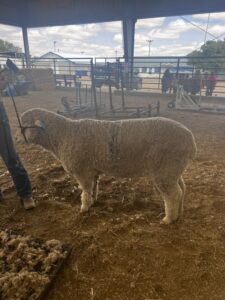
This week, one of my hosts took me with them to the US Targhee Sheep Association National Show and Sale in Miles City, Montana. One of my host’s daughters has a small, registered flock of Targhee sheep. She’s not in town this summer, so we took one of her rams to Miles City to show and then sell.
On Wednesday morning, we loaded up the ram and made the three-hour drive up to Montana. Wednesday evening was check-in, and as we arrived at the fairgrounds, the parking lot was full of trailers and crate carriers of all types. Since we only had one ram, we put him up in a cage on the back of the truck. We checked in and got the ram settled into his pen for the night, then looked around at the other sheep that were there. People who raise Targhee sheep from all parts of the country were at the fairgrounds that night. Besides Wyoming and Montana, I saw a few license plates from Minnesota, Wisconsin, and Iowa. We were debating whether or not to fit the ram we had brought, as he would probably show fine without it, but wouldn’t be hurt by a quick brush over and trim. After looking around at the other sheep that were trimmed and brushed, we decided that it would probably be a good idea to attempt to fit the ram.
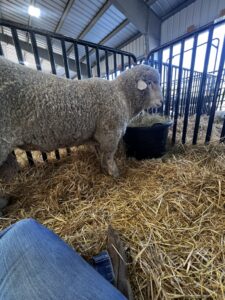
On Thursday morning, the junior show had started. We watched the junior show for a little while, and my host had me closely observe how they were showing and the techniques they used while holding their sheep. Later that morning, we began to fit the ram. My host hadn’t fit the sheep much before, as that was often the job her kids took over, so this was somewhat of a new experience for both of us. When we finished picking the majority of the straw off of the ram, we then started raking his wool. Raking the wool helps to untangle the knots that can form on the outside of the wool and gets the wool ready to be carded. When the ram was all raked through, we then began to card him. A carder is a tool that has a hook-like shape on the end that pulls the wool out so it is fluffier and ready to be trimmed. Everyone at the show was working hard on getting their sheep to be perfectly fitted to their standard. For some people, this included using electric clippers as well to smooth out the back and legs on their sheep. We didn’t trim the ram much, just a little bit around his face and feet, and some on his stomach to even out his sides, just using a pair of shears. The fitting process took us most of the morning and into the afternoon, and once we were done, we visited with the other people who were there. We met a group of Australians who gave us some insight into the sheep and farming industry in Australia, which I found very fascinating. I also met the majority of the other families that were showing and selling sheep, as showing these sheep is often a family affair, and it isn’t a huge crowd.
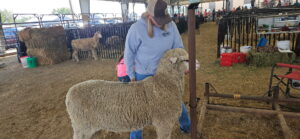
Friday was the day of the show. We were up early in the show lineup, so we arrived at the fairgrounds early and began to pick the straw off the ram once again. Everyone was working on finishing and touching up their sheep as the show was about to begin. I entered the show ring with my host and held and led the ram as she positioned his feet. I learned that the stance and gait of a ram play a vital role in the effectiveness of its breeding ability, so positioning its feet right shows the ram’s capability. The judge walked around the ring and examined each ram, checking their muscle, stance, gait, and wool. This show was a Targhee show, so the rams were being judged on their adherence to the breed standards in addition to everything else. The ideal Targhee is thick, deep-bodied, and free from skin folds, so the judge also took that into consideration while judging each class. We ended up placing 7th out of 11 rams in the yearling ram class. The placement in the class helps buyers identify desirable qualities in a sheep they are looking to buy. After the show, we put the ram back in his pen and visited with some more people. Later that afternoon, there was a seminar about wool judging where I learned about the different desirable traits when looking at wool, such as staple length, micron number, and comfort factor. That night, there was a banquet where all of the junior awards were given out for both the animals shown and showmanship. There were also awards given out to the adults for the best sheep in each category.
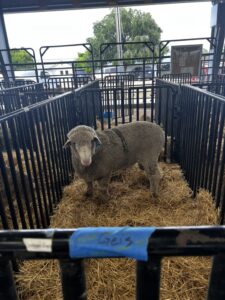
Saturday morning was the sale. It was kind of nerve-racking getting ready for the ram to sell. My host was hoping to sell the ram for at least a thousand dollars, and the floor was set at three hundred. The champion and reserve champion sheep sold for much more than any other place. However, this trend didn’t always follow through with the following third, fourth, fifth, and so on, placed sheep. The third-place ram only sold for four hundred dollars, while the fifth- place ram sold for nine hundred. As my host stepped into the show ring, I listened and watched in anticipation as the auctioneer quickly announced prices climbing higher and higher. Two buyers got into a bidding war on the ram, and the thousand-dollar goal was quickly surpassed. The price continued to rise until the other buyer backed down, and the ram sold for twenty-five hundred. I was extremely impressed because even though we placed 7th in the show, we had the third highest selling ram in the class of yearling rams. Watching the sale was pretty entertaining as the auctioneer spoke faster than my mind could comprehend, and friendly faces from the night prior turned intent and focused. After the show was over, everything was quickly wrapped up. We helped take down the pens as everyone began taking their newly purchased sheep to their trailers and headed off.
I also learned a lot about the NSIP, which stands for the National Sheep Improvement System. NSIP sheep had their own class, which was much smaller. NSIP is a program that producers sign up for and pay for, in order to send in the data they have collected on their flock. The NSIP helps sheep producers improve profitability through their sheep’s genetic information. All of this information is made public and helps producers know and learn about what they can do to improve their flock.
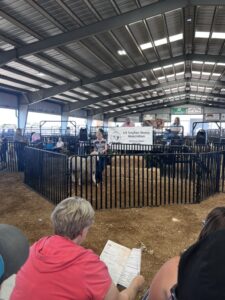
This week gave me a lot of insight into what goes into both showing and selling registered sheep, especially in a smaller, more specialized breed like Targhees. I learned a ton, not just about fitting and showing, but also about what makes a good ram, how the sale process works, and how programs like the NSIP help producers improve their flocks. I had a lot of fun meeting people from all over, hearing their stories, and seeing just how much effort and care goes into getting these animals ready for the ring.
Submitted by: Sydney Farley
Edits by: GrowinG Internship Team