Holistic Herding and Grazing Strategies
#bfrdpwy #aginternship #RightRisk
This week, I discussed with the owners of the ranch how they maintain biodiversity in their pastures to both increase the diversity in the diets of the cows, as well as benefit the soil health and avoid usage of herbicides. One example, I found particularly interesting, was the use of plant species to indicate the soil health in particular pastures. I gained an understanding [that] of the presence of purple and yellow mustard plants in a few pastures indicated they had been over-grazed in past years. The owners of the ranch seek to maintain a wide array of grasses in their pastures to increase biodiversity and, therefore, the overall defenses of their pastures against pests and diseases. Many cow/calf operations in Wyoming produce hay alfalfa alone, and maintain a monocrop, but Perry Cattle has found great success in keeping a relatively un-altered grassland and, therefore, has seen healthier soil and [fewer] less pests/weeds.
I built on my knowledge of Holistic Resource Management this week, specifically on the rotational grazing practices maintained on the ranch. This system is perfectly timed so as not to allow fields to rest for too long, because impact from grazing animals is necessary in brittle environments to incorporate seeds into the soil and break up dying plants to encourage a mulch of sorts to form. The term “brittle” indicates an area will return to a state that is not fit for growing if left alone or if overworked, such as Wyoming, and the term “non-brittle” indicates an area is very fertile and things will grow without human interaction, such as in Oregon or Washington. I also learned about how, by using HRM techniques, you can improve the health of the soil so that it has better water retention ability.
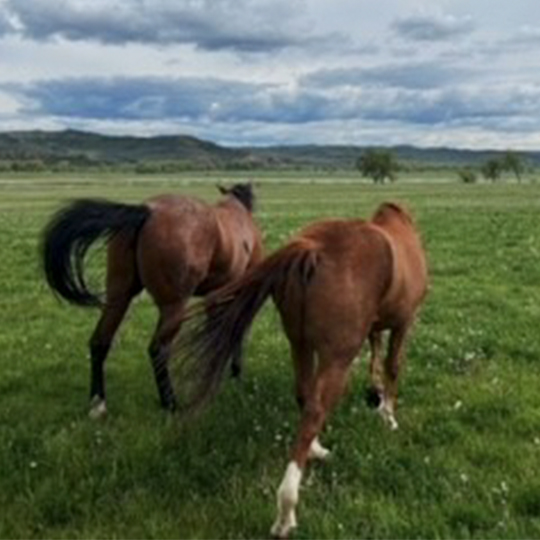
Looking towards the cattle, this week I was able to participate in a “shipping day” or the loading of cows that are sold onto a truck for shipment. We began with herding the cattle, two of us in ATVs, and one of us on a horse. We gathered 80 head of cattle, 40 heifers and 40 calves, into the corral and began the process of separating the heifers from their calves into two, separate corrals. I learned that this is done to ensure calves are not trampled during shipment and can make it safely to their destination. We then worked on loading the cattle in numbered sets onto the truck by moving them up the chute via horse.
This week, I would challenge how cattle can be moved in a lower stress way that prevents behavior such as running or dispersing. I was very interested this week in observing [the] cattle’s behavior around humans and other animals such as horses and how their tentative demeanor can be capitalized on to move them in a more effective manner. I think that the alterations made on the ranch to rotate cattle between pastures in accordance with techniques designed by Bud Williams has been incredibly effective and I would challenge how they could be improved upon to decrease the anxiety in the animals.
At this point, I would really love to learn more about herding more effectively in relation to an animal’s “flight zone.” I would love to get more practice with herding with principles designed by Bud Williams that decrease an animal’s anxiety when moving between pastures. I am curious as to how using dogs or moving cattle on foot creates a difference in the stress levels of animals in comparison to the use of horses or ATVs. I also have questions about how plant species, such as dandelions, will disappear from a pasture on their own once their life cycle is complete.
I plan to use what I’ve learned in the past week to look [further] more into grazing techniques such as those designed by Bud Williams and Temple Grandin that look into the behavior of the animals and how the motives of human owners, such as movement between pastures, can be achieved more easily while decreasing the instinctual anxiety of animals such as cattle, goats, etc. I will continue to use what I learned this week to build up my knowledge base of ranching in brittle environments and how more sustainable ranching operations can be achieved with the use of carefully-planned techniques that follow the principles of Holistic Resource Management.
Submitted by: Jamie Kaste
Edited by: GrowinG Internship Team