
One New Fence, Coming Up
#bfrdpwy #aginternship #RightRisk
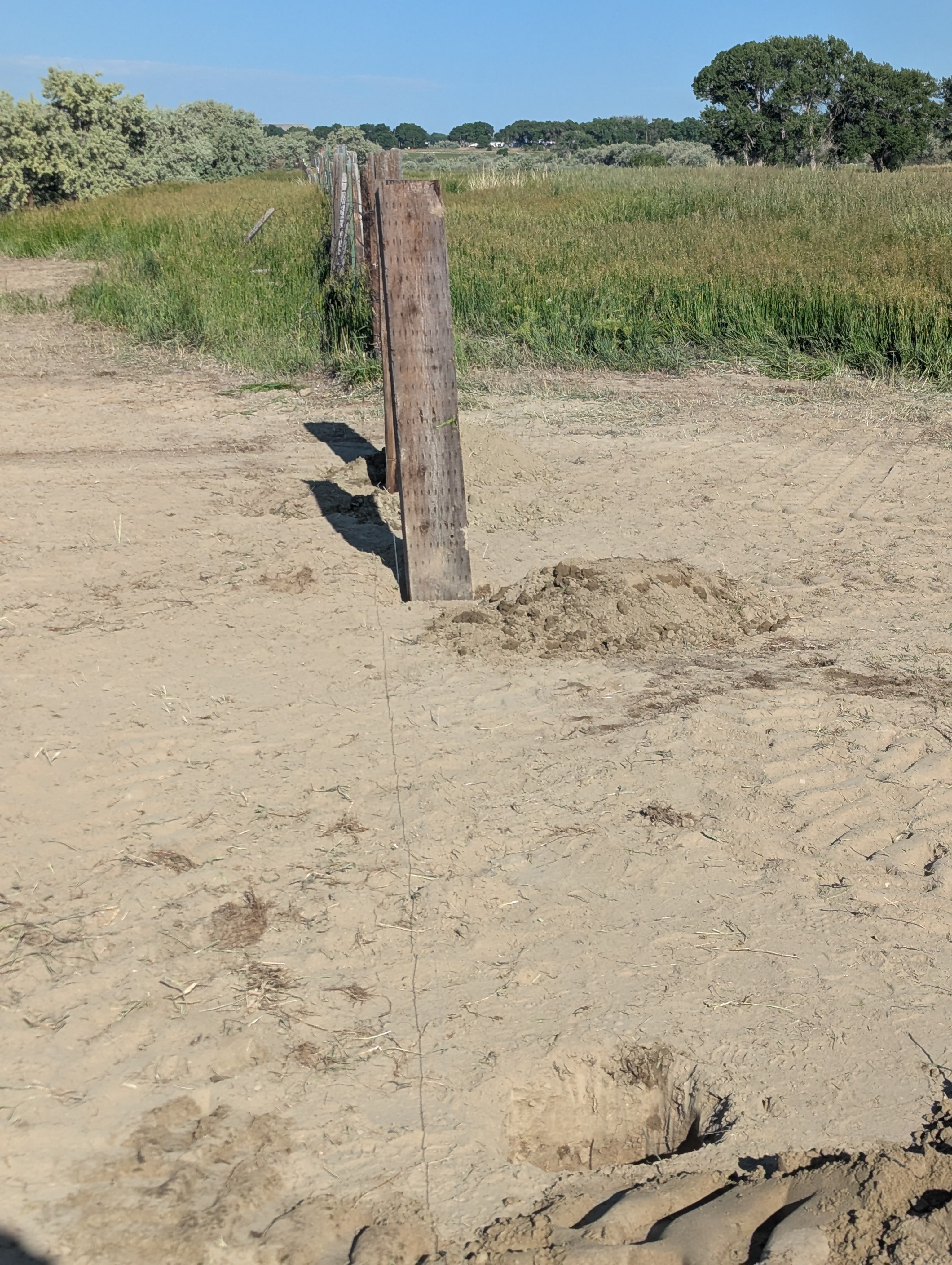
Outside of the daily chores, our big project this week was putting up a new fence on the corner between us and the neighbors. The fence there had to be torn down because the ground on the neighbor’s side was caving in and our fence was in the way of the equipment that needed to get through. On Thursday, the ground work was finished and we both were able to put our fences back up.
We started by digging three holes along a string for the railroad ties that would serve as the corner posts. The string was used to help make sure that the new corner posts lined up with the rest of the fence that was still standing. The holes were dug to a depth of three feet and two inches to make sure that the posts don’t fall over and don’t move if something pushes against them. A tractor was used to help put the railroad ties into their holes. We then put dirt in around the ties and tamped it down every few shovelfuls to keep the posts from shifting on us. We were constantly checking to make sure that the posts were straight using a level.
After all of the corner posts were put in, we put in one treated post for building an h-brace with and two t-posts to reach to the original fence. The treated post was put in at a depth of about two and a half feet. The dirt was put back in the same way that we did for the railroad ties. Then to make the h-brace, we measured where we wanted the cross beam to go, marked both the treated post and the railroad tie, and made four or five horizontal cuts in the wood with a saw zaw. Then we would chisel on the vertical edge between the cuts to pop out the chunks of wood, slide in the cross beam, and screwed it in. I was told that normally large nails are used to secure the beam, but my host and the neighbor both thought that using screws would be easier.
We repeated the process on the three other corner posts, turning them into h-braces, with the center post being where the two braces met. The end posts were not cut all the way through like we did for the first h-brace, though. It was only cut halfway to help hold in the post by giving it something to push up against.
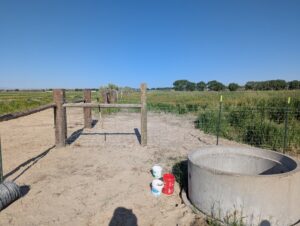
On Friday, we went back out to string fencing across the posts. A wire fence made up of squares was put up first. The wire was wrapped around one of the posts, then pulled using a pipe with four hooks, a chain that attached to the original fence, and a ratchet that went between the chain and the pipe. We then went through and stapled in the wire at four different points on each of the posts it passed by to hold it in place and keep it tight. I learned that its best if the staples go in at a slight angle to keep it from splitting the wood as it is hammered in. After the wire with squares, we put up three strands of barbed wire: two on the top and one on the bottom. A similar method was used to string it across the posts, but a fence puller was used to tighten it rather than a rachet.
The whole process was repeated on the backside of the fence, connecting the neighbor’s fence to ours. Through this process, I learned that it is important to know your neighbors because for a project like the one we had to do, it was helpful for us to be working together rather than on our own. There was also a lot of sharing of tools and fencing supplies between my host and the neighbor, which I think helped make the fence more of a shared thing that both parties would look after rather than all one person’s that if it breaks it’s all that one person’s responsibility to fix.
Some questions that I have following this week are: What is the smallest a corner post can be to still be effective? Is there a height requirement for posts, especially those that are used to make h-braces? How far apart do posts need to be when making an h-brace? Is there a type of wood that works best for fence posts? I learned that oak is not the best because there was an oak railroad tie that was used as a post and it was extremely difficult to put the staples into that particular post.
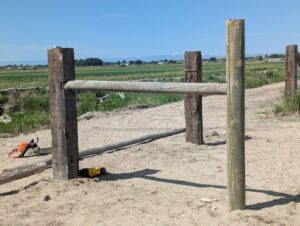
The concept that I would challenge this week is using railroad ties for livestock fencing. I know that railroad ties are treated with chemicals to help them last longer. I am not sure if those chemicals are safe for animals. The hair sheep will be rubbing on the posts and some of the cows will chew on the wooden posts. These animals could potentially be harmed by the chemicals, especially the cows since they are ingesting them. I also read that the chemicals from railroad ties can leach into the soil. If the plants around the posts can pick up those chemicals, then the animal that eats the plant could be harmed, as well as the human that consumes the animal. I think using posts specifically made for agricultural purposes would be better because then there is less of a chance for chemicals and if there are chemicals, they won’t hurt the animals.
The information that I learned this week is of a practical and skill-based nature. This is something that I can definitely see myself using when I have my own ranch, or even working on someone else’s. I also think that being willing to help neighbors out is not just a skill but a character trait that is not seen that much anymore, but is still necessary. We as a society spend so much time focused on ourselves, we forget about those around us. I think that we could accomplish a lot more if we were to slow down and help those that are around us.
Submitted by: Anna Agee
Edits by: GrowinG Internship Team