
Gaining Far More Than Expected
#bfrdpwy #aginternship #RightRisk
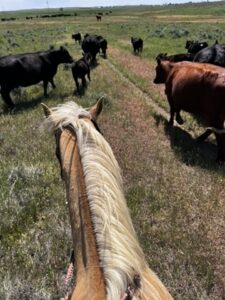
One of my main goals for this internship was to gain hands-on experience working with large animals. This week, I worked with animals of all kinds and was able to observe and gain a deeper understanding of how they interact with one another and how they respond to us. Each day this week was filled with a different story (and lesson) regarding some kind of animal interaction.
On Monday, the vet came to draw blood from a ram and measure its scrotum size in preparation for a show later on this summer. While the ram put up a fight to catch and hold, we were ultimately able to soundly perform the blood draw and measurement. Upon completion of the scrotum measurement, the vet emphasized that the scrotum size of this ram is similar to that of a bull. I learned that scrotal circumference in rams indicates higher fertility, meaning that the larger the scrotal circumference, the more viable semen is produced, which is essential for breeding. It also indicates that there is a higher daily sperm output and a greater level of testosterone in the ram, which are desirable characteristics in a breeding ram.
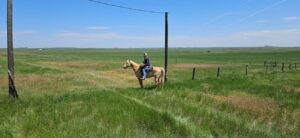
On Tuesday, the importance of community and communication in ranching was, yet again, emphasized. While checking the heifer pairs in one of the pastures, I noticed that one heifer cow had strayed away from the rest of the group. She had wandered out into a corner bordering the neighbor’s pasture. At the time, looking out into the neighbor’s pasture, it wasn’t evident that there was a bull in with their cows. We called the neighbor and then found out that there was, in fact, a bull in with his cows, which meant that we had to move our heifer cow pairs to another pasture away from the neighbor’s bull. On this ranch’s operation, there is enough land to move the heifer cows away from the bull into another pasture, but this begs the question: what would a smaller operation do in this situation? How do you prevent neighboring bulls from jumping the fence if you are unable to move the cows anywhere else?
On Wednesday, we moved the heifer cows on horseback to a pasture south of where they had been. When moving cows, I have learned that it is much more efficient and easier to move them on ATVs, motorcycles, and four-wheelers. Especially if a rogue calf decides to break away, or a feisty heifer cow leaves the group, it is much easier and safer to take off after them in a vehicle than on a horse. However, just like humans, it is important that horses get exercised daily in order to maintain their musculoskeletal and cardiovascular health. Taking the horses to move the cows allowed them to exercise significantly more than flagging in the round pen. As we were riding to gather the cows, I noticed that my horse would see things that I missed. When we were pushing the cows, my horse kept veering to the left, which at first irritated me as I kept trying to correct him to go right. Eventually, we turned to the left and noticed that there was a calf that was left behind, and headed back toward the calf to push it in with the rest of the group. Oftentimes, horses are treated more like pets than working animals, so having a horse work and
perform a job was impressive to watch and take part in.
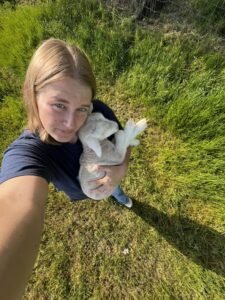
On Thursday, it seemed like everything on the ranch was going wrong—animals were either escaping or falling ill. It was one of those rare days that felt completely out of control, like a train going off the rails. Of course, not everything on the ranch was actually going wrong, but there were two predominant inconveniences of the day. To start off the day, the rams had escaped their enclosure and found the ewes and lambs on the other side of the road. This is not a favorable scenario, as it was not planned to breed the ewes this early. On top of that, the rams were not very easy to catch. We ended up chasing the rams around for about an hour and attempted multiple different methods to catch them. Ultimately, they were tired enough to just head on back home with a little bit of encouragement as we trailed them in the gators (ATVs). We then went to gather the dry cows to take to the sale barn, and to our surprise, this part of the day was relatively easy. When we came back home, we decided that we would go tag the new lambs that were born on Tuesday night. When we went to check these lambs, one of them was extremely weak and barely able to stand up. The other was also feeble, but could stand up and follow its mom a little better. We decided that the best course of action for the lambs was to move them to a confined space with the ewe. The best theory we had as to why the lambs were so weak almost 48 hours after birth was that a bum lamb was able to escape and steal the colostrum produced by the ewe. When we had the ewe in a more confined space, we were able to milk her and tube the sickly lamb with her milk. This was the only option that could help the lamb at this point, as without having access to the colostrum from its mother, the lamb was lacking vital nutrients, antibodies, and energy necessary for survival. Watching the effect of these lambs not having access to colostrum really demonstrated just how necessary colostrum is for newborn lambs and animals in general. Ensuring that lambs receive adequate colostrum within the first few hours of their life is critical to their survival.
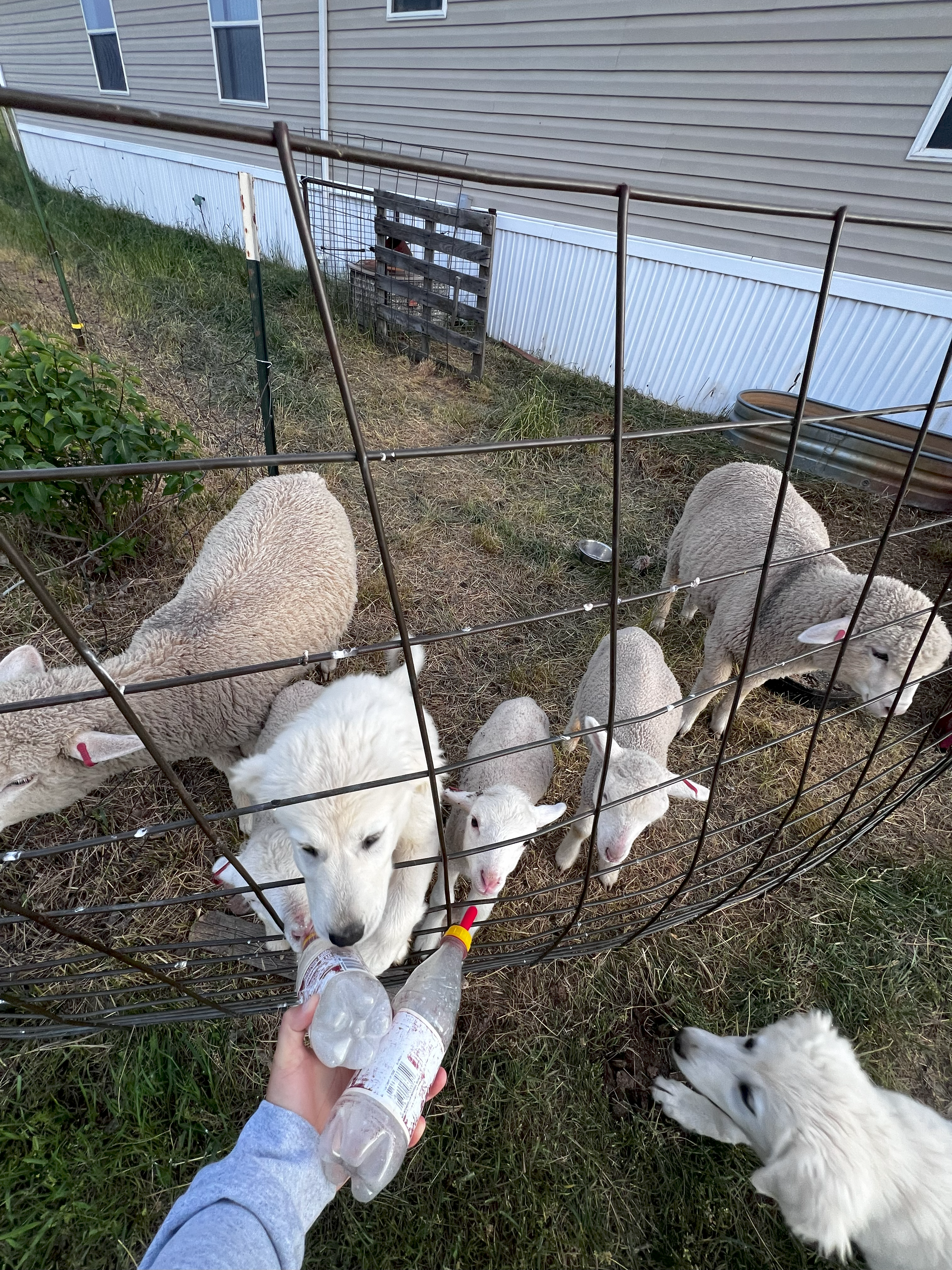
On Friday, the first place I headed in the morning was to the barn to check on the lamb we had tubed the night prior. Much to my disappointment, the lamb had died at some point overnight. The other lamb was still alive, but now also extremely weak as it likely hadn’t been nursing overnight and continued to get weaker with time. I now knew and accepted that at this point, the other lamb likely wouldn’t live overnight. I spent most of the day on Friday discing the field in preparation for it to be sprayed. Even the farming aspect of Friday can be tied back into the animals, as the crops produced in these fields are used to feed the animals. After farming, I went back to check on the ewe and her lamb. We decided to place a bum lamb in with the ewe, in hopes that the ewe would eventually accept the lamb. The other lamb passed away overnight on Friday, so now both of the ewes’ biological lambs had died. We then placed another bum with the ewe, so she now has two bums. I learned that it’s not a quick or easy process to get an ewe to “adopt” two lambs that aren’t hers. This was, actually, surprising to me as I have noticed that mothering instincts in sheep are not as strong as in other species. The first two days of getting the ewe to accept the bums were a little rocky, but with every feeding, the ewe seems to be getting better at accepting the new lambs.
Looking back on this week, I’ve realized just how much I’ve grown both in knowledge and confidence. While my main goal was to gain experience working with large animals, I ended up learning far more than I expected. I saw firsthand how important it is to understand animal behavior, communicate effectively, and adapt quickly when things don’t go as planned. Whether it was chasing down rams, helping a weak lamb, or watching a horse notice something I didn’t, each moment added to my understanding of what it really takes to run a ranch. There were hard moments, but even those taught me something valuable. Ranch work is full of ups and downs, but with every challenge this week, I was able to grow and learn from them.
Submitted by: Sydney Farley
Edits by: GrowinG Internship Team