
Hands-On vs. Hands-Off
#bfrdpwy #aginternship #RightRisk
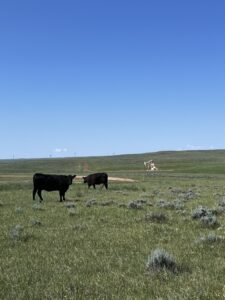
This week, I focused on observing and reflecting upon the differences in livestock management between the two operations on the ranch. On this ranch, there are two different operation styles for both the sheep and the cattle. There are cattle that have been raised with a more “hands-on” approach, and cattle with a more “hands-off” approach, which is the same with the sheep.
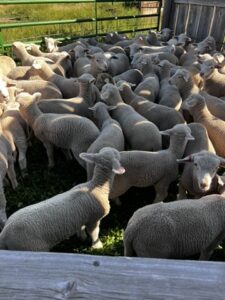
The more “hands-on” approach includes shed lambing and tagging calves shortly after birth when they are paired up with the cows. In this approach, it is easier to monitor health issues and catch things like weak lambs, scours, or mis-mothering earlier on, leading to quicker intervention. Tagging the lambs shortly after birth made it easy to track their health issues and history, as each animal is recorded and kept track of. For instance, when one of the ewes had triplets, one of the lambs was kept as a bum so the ewe could to conserve her energy better. It also made it easier to assess which sheep needed to be where based on their health and age. With cattle, the tags that the calves were given corresponded to their mother’s tag, allowing us to easily identify if a calf by a cow is with its respective mother or not. This helps a lot when driving through the pasture to check that the calves are nursing and bonding well. I also got to observe a more “hands-off” approach to sheep and cattle management while branding and docking. In this approach, ewes lambed out on pasture, and the calves were left untagged after birth. In this approach, only the steers were tagged at the time of branding, with the tag simply signifying that the calf is a steer and not a heifer. This approach likely causes less stress on the animals in terms of human interference, but leaves a greater possibility for problems to go unnoticed. If a calf isn’t nursing or a lamb is too weak, that animal likely won’t survive, as the problem is either recognized too late or not at all. It is much harder to catch and treat early signs of disease or weakness in a “hands-off” livestock management approach.
Observing these two different livestock management practices made me challenge the idea that less handling is better for the animals. While minimizing stress is important, there is a difference between unnecessary handling and purposeful handling that benefits the health of the animal. In a “hands-off” approach, it is extremely easy for health issues to go unnoticed, and when the animals are not getting checked daily, small problems can grow rapidly and quickly. In the “hands-on” system, although this approach requires much more labor, it can help improve survival and long-term health. A simple, quick check over when tagging calves after birth can catch small things that might be unnoticed, such as poor suckle reflexes or scours. However, too much handling, especially if it is done roughly or inefficiently, can cause harm to the animal as well. For instance, excessive handling may stress a ewe into rejecting her lamb, or cause a calf to get caught in a fence and injure themselves.
The first question that came to my mind when observing these different livestock management styles was: How do producers decide what kind of practice to adopt? I believe that in a smaller operation, a more “hands-on” approach would be necessary and helpful. However, in a larger operation, such as the one run by this ranch, it is more beneficial to have a “hands-off” approach. The time and labor associated with an intensive “hands-on” practice wouldn’t be worth the benefits when you have a large herd, as the labor and time increase with herd size. So, where would the break-even point be? At what herd size is it truly beneficial and economical to closely monitor the animals, and when does it become costly and ineffective? How can both livestock management practices be supported when it comes to preventative care? In a “hands- off” system, we focus more on herd-level health instead of focusing on the health of each animal. Is there technology out there that could bridge the gap between the two management styles? Could thermal sensors or remote cameras help monitor herds that are out in pastures farther away and help assess when intervention is needed? What can be done to further prevent death and diseases in herds that follow a “hands-off” management approach?
This past week allowed me to compare the differences between “hands-on” and “hands-off” livestock management. Seeing both styles in action helped me better understand the benefits and challenges that come with each method. With that knowledge, I feel more prepared to apply what I’ve learned as I move forward in my career in veterinary medicine. I now have a clearer perspective on when close monitoring and intervention are worth the extra effort, and when it’s more practical to take a step back and let animals do what they’re naturally built to do. I also learned about the importance of tailoring animal care to the scale and structure of the operation. What works well for a smaller group in a shed might not be realistic for a large herd spread across a large pasture. Instead of trying to force one system to fit all, I’ve learned to think more critically about how to adjust management practices to fit the situation. In conclusion, livestock management is about being aware, being adaptable, and making thoughtful decisions based on what’s best for both the animals and the operation.
Submitted by: Sydney Farley
Edits by: GrowinG Internship Team