
Feeding and Weaning Bottle Fed Lambs
#bfrdpwy #aginternship #RightRisk
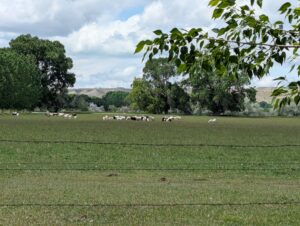
This week has been a slower week on the farm. We have mainly done the daily chores which consists of feeding the laying hens, feeding and adjusting lights on the chicks, moving the sheep from their pen to pasture, moving the pasture chickens to a new spot, and moving cattle to a new paddock. We also fed five lambs: four whose mothers are unable to produce enough milk for them and their siblings, and one who was rejected by his mother.
I learned from my host that these five mothers are going to be culled because they are lacking qualifications needed to remain in the flock. Two of the biggest qualifications needed to remain in the flock are good milk production and a good mothering instinct. The ewes that cannot produce enough milk for all of their offspring lack adequate milk production and the ewe that rejected her lamb is not a good mother. Some of the other qualifications that are looked for in the sheep are a complete shedding of the winter coat (my host has hair sheep), and if the sheep is approachable and able to be worked on.
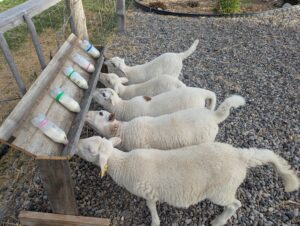
The lambs had to be weaned this week because the herds were going to be combined and moved to a pasture far away from the house next week. The lambs were fed using plastic soda bottles that had red rubber nipples screwed on. Raw cow’s milk was added to their milk replacer to add probiotics for the lambs. They were originally fed three times per day, and last week they were reduced down to two times per day to begin the weaning process. Since there were five lambs, my host had built a bottle holding station that allowed all five lambs to be fed at once. It is essentially a wooden rack with holes drilled in the bottom that allow the nipple of the bottles to come down allowing the lamb to drink. The back holds the bottles in a tilted position so that the milk is always flowing into the nipple.
The smallest lambs were weighed before reducing the number of times they were fed to make sure that they were more than thirty pounds, which is weaning weight for a lamb. I was told by my host that usually when weaning, the amount of milk in the bottles increases. We didn’t do that this time because the lambs rarely finish their bottles. The milk replacer brand also changed which, under brand recommendations, reduced the amount of milk given to the lambs.
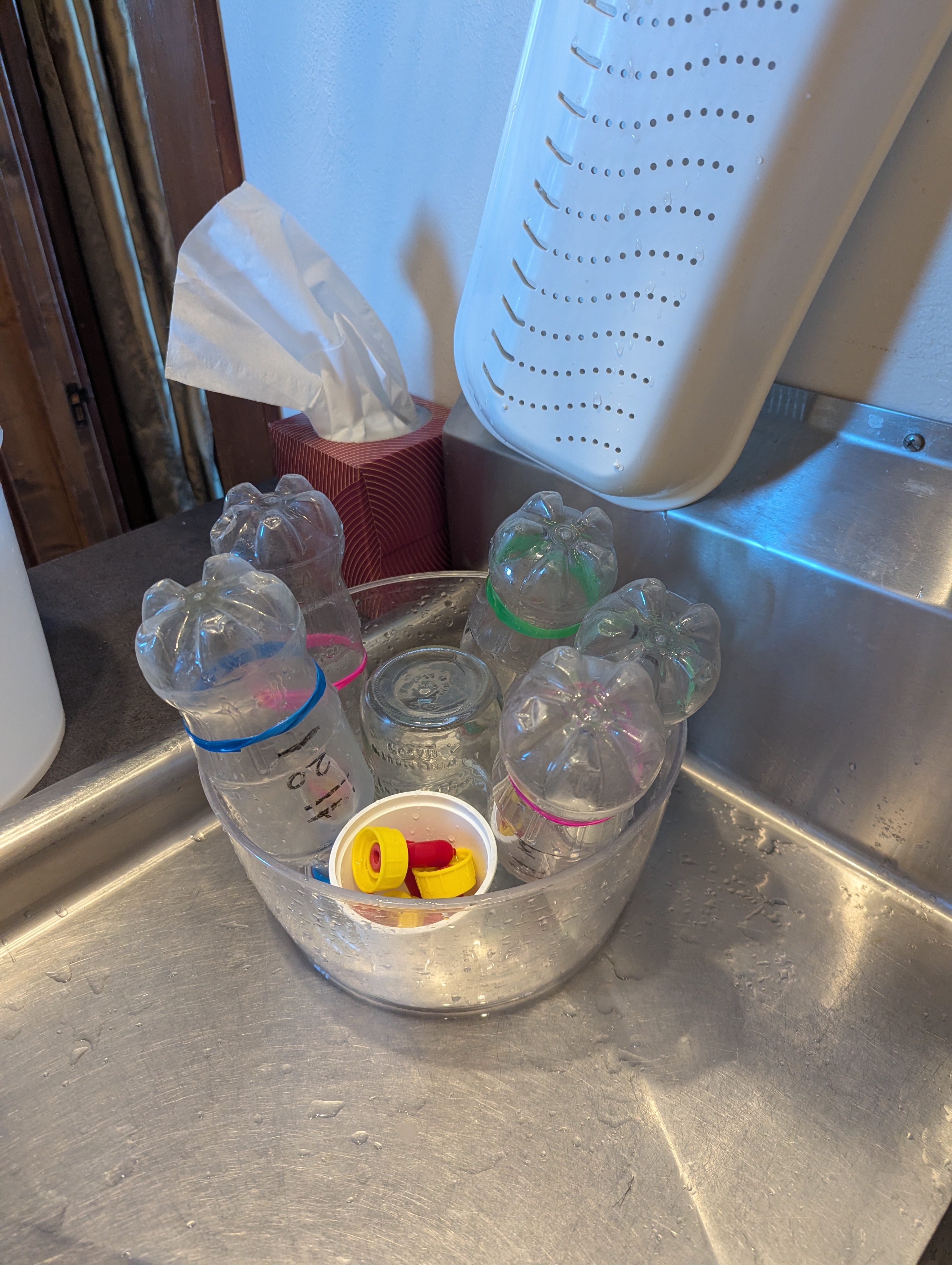
The last day of feeding bottles was on Friday. The lambs were given their two bottles, then the soda bottles were put in the recycling bin and the nipples thoroughly washed to be stored and used for next year. We quit feeding in a “cold turkey” fashion because we needed the lambs to be done so that the entire flock could be moved to a new pasture.
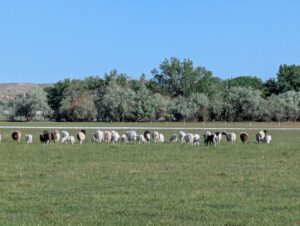
The yearling flock that is going to be harvested this year and ewe and lamb flock were combined on Thursday. They were originally kept separate because the guardian donkey my host has was a little rough with the yearlings at the beginning of the year, and he didn’t want the lambs to become injured. We watched the two flocks for a while as they joined and mingled together. The sheep would circle and rub against each other as they got reacquainted. The donkey was gentle with the new sheep and sniffed them as they approached his original flock.
A concept that I would challenge is weaning the lambs “cold turkey”. There seems to be more stress put on the lambs, especially the one who was rejected. I think that if we had the time, weaning the lambs in a more gradual fashion would have been better for them.
Some questions that I still have after this week are how to tell if an ewe is able to support all of her lambs? How much milk does an ewe need to produce to support two lambs? Is it possible to milk an ewe that over produces milk and save it for a lamb that needs to be bottle fed? If the milk is able to be saved, how long would the milk keep in both the fridge and the freezer?
The information that I learned this week about sheep I will definitely use when I start my own ranch, especially the requirements for a breeding ewe. I know that it is very important for an ewe to have the very best traits in the flock and if she doesn’t have that, then she is not worth keeping. I also think that having an ewe that is capable of producing milk for both of her babies is important because if she doesn’t then I have to do the job of feeding one or both of her babies for her. This takes me away from other tasks that I need to do which can slow down how much I can accomplish in a day.
Submitted by: Anna Agee
Edits by: GrowinG Internship Team